Published on 6 October 2026 620 views
Beyond Superstition: How GUDCON is Quietly Revolutionizing Modern Mindfulness
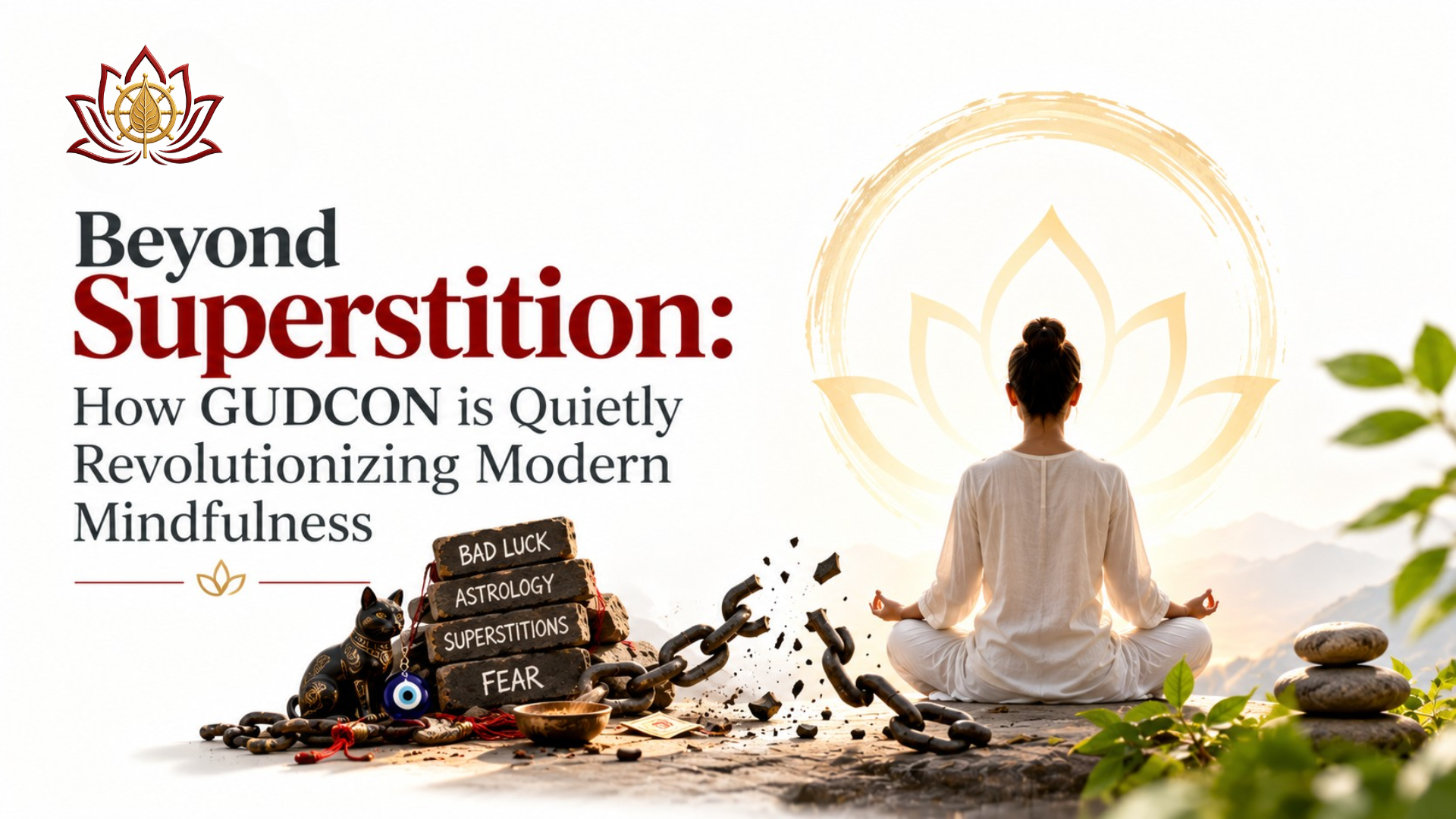
GUDCON’s ultimate purpose is not merely to build an institutional structure, but to spark a cultural shift toward an aware, compassionate, and balanced society. By stripping away blind superstition, restoring internal self-reliance, and offering a practical framework for mind-training, the movement provides a clear path through the disorientation of modern life.
1. Introduction: The Modern Restlessness and the Search for Authentic Peace
We live in an era of unprecedented speed and technological convenience, yet the human mind has rarely felt so profoundly restless. We accumulate vast knowledge, yet drift away from genuine self-awareness; we surround ourselves with physical comforts, yet experience an underlying emotional emptiness. In attempt to soothe this chronic tension, modern culture offers quick-fix motivational slogans and performative spirituality superficial rituals that promise instant relief but leave the seeker spiritually starved.
Rising quietly against this noise is GUDCON the Global Union of Dhamma Contemplation. Known natively as the Namo Buddhay Movement, GUDCON is not a commercial enterprise, a dogma, or a new religion. It is a modern awareness and Dhamma movement rooted in the 2,500-year-old timeless teachings of Gautam Buddha, dedicated to restoring simplicity, purity, and conscious living to everyday life.
At its heart, GUDCON operates through four sacred purpose pillars: Buddha Chintan (deep contemplation on Buddha's wisdom), Pakhanda Mukti (liberation from superstition and blind ritual), Shanti Sthapana (establishing internal and social peace), and Dhamma Prachar (spreading practical wisdom across the world). By returning to the authentic core of Buddha’s message, GUDCON offers a practical blueprint for turning away from external validation and anchoring yourself in present-moment clarity.
To understand how this movement bridges ancient wisdom and contemporary psychology, we must examine the core principles that define GUDCON's approach to human awakening.
2. Takeaway 1: Beyond Blind Faith : Dhamma as Practical Mind Training, Not Blind Ritualism
Spiritual practice in the modern world is too frequently reduced to external transactions performing rigid rituals, offering prayers for material favors, or clinging to unexamined dogmas. GUDCON radically breaks away from this approach through Pakhanda Mukti, the active dismantling of blind faith and superstition. Within this framework, Dhamma is not an external deity to be placated through ceremony; Dhamma is defined directly as correct thought, correct action, and correct meditation.
GUDCON grounds its methodology in Buddha’s foundational framework: the Four Noble Truths (Dukkha, Samudaya, Nirodha, Magga). Life contains suffering (Dukkha), but suffering does not originate from external bad luck or mystical forces it stems directly from internal craving and attachment (Samudaya). Because suffering has an internal cause, it has an internal cure (Nirodha), reachable through the practical psychology of the Eightfold Path (Ashtangik Marg).
Instead of asking you to rely on external miracles, GUDCON redirects your total focus inward toward personal accountability, psychological clarity, and daily self-observation (Sadhana). Spiritual purification is not about altering external circumstances; it is about training your mind to observe thoughts without distortion, dissolve clinging, and act with conscious intent.
"Suffering doesn't come from outside. It arises when the mind clings to something." - GUDCON Daily Wisdom
3. Takeaway 2: The Bamboo Metaphor : Invisible Root-Building Precedes External Transformation
Modern culture conditions us to demand immediate visible results, constant public validation, and rapid metric-driven growth. When inner transformation does not produce fast external rewards, seekers often sink into despair and abandon their practice. GUDCON addresses this psychological trap through the parable of the Chinese bamboo seed.
When you plant a Chinese bamboo seed, nothing visible breaks through the soil for four full years. You water it, tend to it, and protect it, yet the ground remains completely bare. During these quiet years, the practitioner is forced to endure profound internal struggle facing self-doubt, wrestling with the urge to give up, and braving the inevitable ridicule of onlookers who laugh and claim your labor is entirely in vain.
Yet underground, out of sight, the bamboo seed is constructing a massive, intricate root system. When the fifth year arrives, the soil finally splits, and the bamboo explodes upward, growing over eighty feet tall in a matter of weeks. The rapid explosion above ground was only possible because of the invisible groundwork laid deep below.
Your spiritual journey functions in the exact same way. When you sit in daily meditation, study scripture, and practice quiet self-discipline without immediate external changes in your life, you are not stagnating—you are extending your roots. Without those subterranean anchors of character and mind-training, any sudden external elevation would cause you to collapse during the first atmospheric storm of adversity.
"When you feel like nothing is happening in life, remember that work is happening deep inside—your roots are growing stronger."
4. Takeaway 3: True Prayer Is Internal Self-Trust, Not Asking for External Miracles
Conventional prayer is often an act of desperation—an egoic request for external forces to alter reality to suit your personal desires. GUDCON reframes devotion as an act of profound internal self-reliance (Self-Trust). Real defeat never occurs in the external world; external losses are merely outward reflections. True defeat occurs within you at the precise moment you doubt your own inner voice, reject your raw authentic experience, and adopt society’s distorted mirror to measure your worth.
This self-doubt is systematically built into us from childhood. You were compared to your siblings or neighbors—"Look how well the neighbor's child performs" and measured against arbitrary social metrics where becoming a doctor meant success and becoming an artist meant failure. Forcing a fish to spend its life attempting to climb a tree leaves the fish believing it is fundamentally defective. In the same way, accepting societal metrics leaves you chronically disconnected from your inner truth.
GUDCON illuminates the critical distinction between the noise of Ego and the silence of True Self-Trust:
Ego operates entirely through external comparison, declaring, "I must be better than others." It constantly hungers for social validation, public applause, and superior status. When criticized, the ego shrinks; when praised, it inflates.
Self-Trust, by contrast, operates entirely without comparison. It quietly knows, "I do not need to be better than anyone." It doesn't demand that you be flawless or immune to fear. Instead, self-trust is the courage to face your deep insecurities, acknowledge when you have fallen, and learn from your errors without ever rejecting your fundamental existence or inner divinity.
"Self-trust is not a motivational slogan; it is a deep internal state where you see your weakness and accept your fall, yet never reject your own existence."
5. Takeaway 4: The Mirror Principle : The Universe Reflects Your Internal State, Not Your Words
A foundational insight of GUDCON is that existence functions as a precise, unforgiving resonance engine. The universe does not operate like a verbal dictionary listening to your superficial positive affirmations, nor does it reward performative prayers spoken from a heart filled with anxiety. The universe acts strictly as a mirror: it directly reflects and amplifies whatever state of being you occupy at your deepest internal level.
If you harbor deep-seated fear, self-doubt, or poverty of spirit inside, repeating loud mantras of confidence above the surface will not alter your reality. The mirror of existence bypasses your external words and directly magnifies that internal fear, delivering external circumstances that validate your hidden insecurity.
True alignment cannot be forced by trying to manipulate the mirror or control external outcomes. Transformation occurs when you turn inward, settle into present-moment awareness, and engage in awakened action (Living in the Present). Through daily meditation, your scattered mental energy consolidates. As your mind quietens, your internal state transitions from chaos to trust and as your internal state shifts, the external world naturally realigns in harmony with your silent clarity.
"The universe never supports your superficial dreams; it always supports your internal state of trust."
6. Takeaway 5: "The Living Sangha" : Integrating Dhamma into Daily Life and Community
Philosophy remains hollow if it stays confined to books or abstract discourse. GUDCON translates Buddha’s Dhamma into daily living through the creation of "The Living Sangha" small, accountable, hyper-local communities of practitioners. Through a structured 90-day practitioner progression model (scaling intentionally from 0 to 5, 10, 25, 50, and 100 active practitioners), GUDCON builds a practical ecosystem for spiritual development.
Living in the Sangha is anchored upon three interconnected spiritual foundations:
1. Devotion (Shraddha): Cultivating deep respect, gratitude, and devotion toward the Buddha as the ultimate guide to human awakening. 2. Meditation (Sadhana): Daily practice of mind-training, Mantra Jap (Namo Buddhay), self-observation, and mental purification. 3. Dhamma (Practice): Actively living the teachings through compassion, loving-kindness, and conscious awareness in daily interactions.
This internal practice is ethical and active. Members ground their conduct in the Five Precepts (Panchsheel): Non-violence (Ahimsa), Non-stealing (Asteya), Moral conduct (Brahmacharya), Truthfulness (Satya), and Freedom from intoxicants (Aparigraha).
Furthermore, practitioners express these precepts through seven core organizational values: Compassion (Karuna), Wisdom (Pragya), Loving-Kindness (Maitri), Non-violence (Ahimsa), Discipline (Anushasan), Integrity (Satyanishtha), and Service (Seva). Whether through monthly community gatherings (Purnima Sangati), study of the sacred Tripitaka scriptures, or transparent community service, GUDCON ensures that Dhamma becomes a natural, lived reality rather than an academic theory.
"The Buddha in devotion. Meditation in practice. Dhamma in life." — GUDCON Core Philosophy
Authentic peace is not something to be hunted down in external accomplishments or granted by external authorities. It is built quietly, breath by breath, within the laboratory of your own mind.
“A Final Reflection: Take a moment to step back from the noise of your schedule and turn your attention inward. Are you continuing to navigate your life through the distorted mirror of societal expectations and performative rituals, or are you ready to turn inward, build your invisible roots, and trust the fundamental truth of your own being?”
Published on 6 October 2026 · GUDCON