Published on 22 October 2026 2,669 views
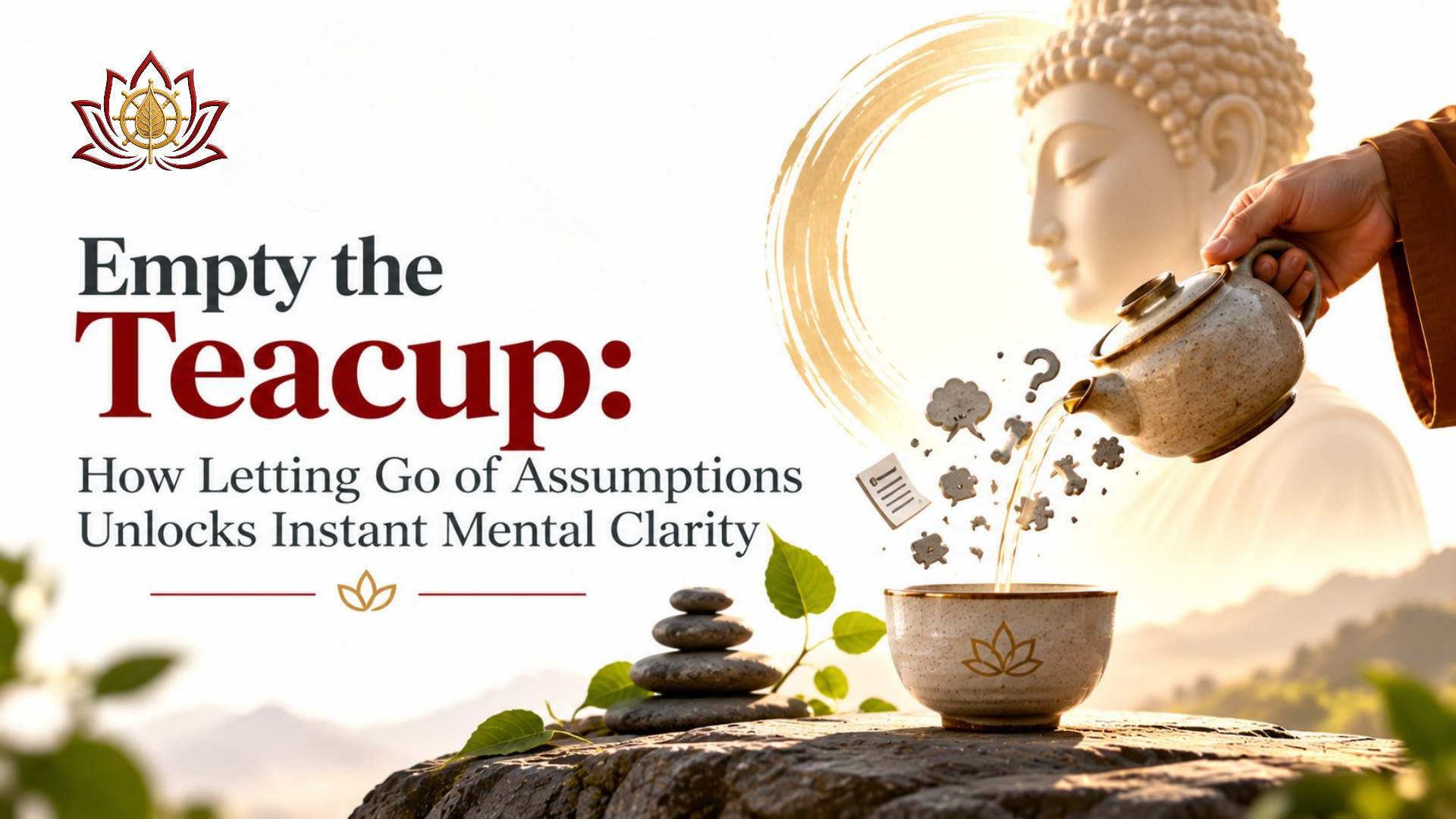
Empty the Teacup: How Letting Go of Assumptions Unlocks Instant Mental Clarity
What assumption or full cup are you holding onto today that is preventing you from seeing the clarity right in front of you?
Unlocking instant mental clarity rarely requires adding more weight to our crowded lives. Instead, it asks for the quiet courage to unlearn. It asks us to empty our mental cups of rigid assumptions so that new wisdom can find a home. It asks us to stop stirring the muddy waters of our emotions, trusting that patience will allow clarity to settle naturally. It invites us to look past superficial forms and embody real virtues in our everyday actions. And finally, it ground
Empty the Teacup: How Letting Go of Assumptions Unlocks Instant Mental Clarity
1. Introduction: The Burden of a Full Mind
Have you ever felt the quiet exhaustion of a mind that simply will not stop running? In our hyper-connected world, we carry an unrelenting internal volume. We overthink conversations, cling tightly to rigid assumptions, and attempt to solve modern overwhelm by consuming even more information. We buy more books, analyze more data, and accumulate endless mental strategies, believing that the key to clarity is adding another piece to an already overcrowded puzzle.
Yet, ancient wisdom whispers a radical truth: genuine mental clarity is not an act of accumulation, but an act of spacious release. True peace does not come from gathering more answers; it arrives when we have the courage to unlearn the quiet biases, egos, and preconceived ideas that clutter our consciousness.
Rooted in timeless Buddhist parables and contemporary Dhamma contemplation practices such as those championed globally by organizations like GUDCON (Global Union of Dhamma Contemplation) this path offers a gentle alternative to mental strain. By learning to empty our internal cups, allowing emotional silt to settle in stillness, and grounding ourselves in daily ethical awareness, we can transform internal noise into clear, unshakable presence.
Empty Your Cup You Can’t Learn What You Already Think You Know
A learned university professor once traveled to the quiet sanctuary of Zen Master Nan-In, eager to discuss the intricacies of Zen philosophy. No sooner had he sat down than the professor began to speak at length, eager to showcase his vast knowledge. He cited ancient texts, debated historical lineage, and parsed complex theories, leaving no silence in the room. Master Nan-In listened peacefully, his eyes soft and receptive, while preparing a pot of warm tea.
When the tea was ready, Nan-In began pouring it into his guest's cup. The golden liquid reached the brim, but the Master did not stop. He continued to pour with a steady hand. The tea spilled over the rim, cascading down the sides of the cup and flooding across the wooden table.
Startled by the mess, the professor gasped, "Master! Stop pouring! The cup is full no more will go in!"
Nan-In paused, setting the teapot down gently, and looked into the professor’s eyes with a warm, contemplative smile:
"Just like this cup, your mind is full of ideas, assumptions, and previously learned things. Until you empty it, how can new knowledge or Zen enter you?"
To experience genuine mental clarity, releasing our intellectual arrogance, ego, and overthinking is a non-negotiable prerequisite. When our minds are saturated with assumptions whether about a challenging project, a personal relationship, or our own limitations there is simply no room for objective reality or fresh insight to take root.
Mindful Application
Consider a moment in your daily life when you felt instantly defensive during a conversation or meeting. Was your reaction based on what was actually being said, or was it dictated by a "full cup" of past assumptions? Before entering difficult discussions or embarking on new learning, take a conscious breath and visually practice emptying your cup. Put aside the need to be right, and cultivate a quiet, receptive openness.
Stop Stirring the Mud, Patience Clears Mental Turbulence Faster Than Force
While traveling on foot through rural villages, the Buddha and his disciples came upon a small river. Tired and thirsty, they hoped to rest and drink, but a passing cart had recently churned up the riverbed. The water was brown, muddy, and thick with dirt completely unfit to drink.
Seeing the muddy water, most of the disciples shook their heads in frustration and walked ahead, eager to find a cleaner source elsewhere. But one disciple chose to stay behind. He did not wade into the water to try to filter it with his hands, nor did he agitate the river by beating it with a stick. He simply sat down on the grassy bank, crossing his legs in quiet stillness.
He watched the river flow. Minutes passed in tranquil silence. Slowly, without any human effort or intervention, the heavy silt began to settle to the bottom. The suspended mud fell away, leaving the surface clear, pristine, and sweet. The disciple leaned forward, drank deeply of the clean water, and walked on with a serene heart to rejoin the Buddha.
When asked by the Buddha why he had delayed, the disciple explained that patience had allowed the river to restore itself. Smiling, the Buddha turned to the rest of his followers to reveal the deeper spiritual truth:
"Just like this river water, when the mind becomes dirty filled with anger, anxiety, jealousy do not try to clean it by force. Just sit quietly for a while, give it time. Everything will organize itself."
Patience (sabr or dhairya) acts as the ultimate medicine (sabya) for a agitated spirit. When we experience emotional turbulence, our initial instinct is often reactive force: we try to analyze our anxiety away, argue through our anger, or make hasty decisions to escape discomfort. But forcefully stirring a muddy mind only keeps the dirt suspended.
Mindful Application
When a sudden wave of anxiety, frustration, or jealousy hits you, refrain from making immediate choices or sending reactive messages. Sit on the figurative riverbank of your mind. Allow the emotional silt to exist without judging it or forcing it to leave. By cultivating patient non-reactivity, the turbulence naturally subsides, revealing the calm, correct path forward.
Look at the Light, Not Just the Flame Embody Virtues Rather Than Idolizing Forms A merchant Brahmin once approached the Buddha while the Awakened One sat in deep meditation beneath the shade of a tree. Waiting patiently until the Buddha opened his eyes, the merchant voiced a heavy, lifelong grief. He explained that despite spent decades worshipping before beautiful idols, performing intricate rituals, and making lavish offerings, he had never once experienced a true divine vision or spiritual realization (darshan).
The Buddha looked at the merchant and pointed to a burning oil lamp nearby. "Tell me, friend," the Buddha asked, "when you look at that lamp, what do you see?"
The merchant replied, "I see the physical lamp, the burning flame, its flickering colors, and the dance of its movement."
"You have seen only its physical shape and body," the Buddha explained gently. "You have noticed its outer form, but you have missed its true property (guna) and its essential purpose (dhamma) which is the surrounding light that dispels darkness. The flame is merely the vessel; the light is what changes the room."
The Buddha continued:
"In the same way, you look at statues of the Divine and perform external worship, yet you fail to absorb the essential virtues (guna) into your own heart. True realization (darshan) does not come from bowing before an image. It comes from absorbing the teachings, embodying core virtues, and practicing righteous action (sadkarm) throughout your life."
External/Form-Based Approach Internal/Virtue-Based Realization Idolizing physical forms, statues, and external structures. Internalizing essential virtues (guna) within one's daily consciousness. Performing mechanical rituals without inner emotional transformation. Dispelling inner ignorance (dhamma) by embodying light and living righteously.
Mindful Application
Spiritual and personal growth is not measured by the philosophy books on our shelves, the mindfulness apps on our phones, or the aesthetic rituals we perform. To experience true clarity, we must transition from form to function. Ask yourself daily: Am I merely carrying the lamp, or am I actually shedding light on those around me through patience, kindness, and integrity?
5. Anchor in Inner Peace Surviving the Tsunamis of Life
In the coastal city of Kamakura, Japan, stands a magnificent bronze statue of the Great Buddha, cast in 1252 AD. Rising over thirteen meters high, it is a testament to extraordinary craftsmanship. Yet its true majesty lies not in its size, but in its resilience.
Originally, this massive bronze figure was housed inside a grand, golden wooden temple hall. But over the centuries, violent natural disasters struck the coastline. In 1369 and again in 1498, cataclysmic earthquakes, fiercesome tsunamis, and typhoon winds swept through Kamakura. The wooden temple hall was completely shattered and washed away into the sea. Yet, when the floodwaters receded and the winds ceased, the bronze Buddha remained standing unmoved eyes half-closed in tranquil meditation, entirely undisturbed by the surrounding devastation.
This unshakable composure amidst ruin echoes the foundational insight that transformed young Prince Siddhartha decades before his enlightenment. At five or six years old, sitting in a garden with his family, Siddhartha watched a hawk swoop down from the sky, seize a struggling fish from a pond, and carry it away. The young prince watched the fish writhe in agony before its breathing stopped.
Tears welled in Siddhartha’s eyes as he sat beneath the tree. In that singular moment, the seed of impermanence (anityata) was planted in his heart. He realized that physical forms, external security, and material structures are fleeting, and that suffering (dukkha) touches every living being. From this realization grew an expansive, boundless compassion (karuna).
The Kamakura Buddha stands open to the sky today precisely because its creators understood Siddhartha's vision: external structures will inevitably collapse, but an inner sanctuary of mindful awareness remains intact through every storm.
Mindful Application
When life's unexpected tsunamis strike a job loss, a broken relationship, or an sudden shift in fortune remind yourself that external circumstances are subject to anityata (impermanence). Your peace does not belong to the outer wooden building; it resides in the bronze foundation of your inner mindfulness and compassion (karuna).
6.Cleanse the Mind with Ethical Guardrails and Daily Discipline
Sustained mental clarity cannot survive in an environment of internal chaos or moral compromise. Ancient texts like the Tripitaka comprising the Vinaya Pitaka (rules of conduct), the Sutta Pitaka (discourses of the Buddha), and the Abhidhamma Pitaka (philosophical analysis) emphasize that a calm mind rests upon the foundation of ethical guardrails.
This framework is actively championed today by modern movements such as GUDCON (Global Union of Dhamma Contemplation). Through its Namo Buddhaya Movement, GUDCON integrates devotional practice, intellectual study, and practical ethics to free practitioners from hypocrisy (pakhandwad) and mental churn.
Central to this daily discipline are the Five Precepts (Panchsheel), which act as practical boundaries to preserve mental energy and inner peace:
* Non-violence (Ahimsa): Refraining from physical and verbal harm; actively reducing anger and hostility toward all living beings. * Non-stealing (Asteya): Living with strict honesty, integrity, and respect for the property and boundaries of others. * Ethical Misconduct Avoidance (Brahmacharya): Maintaining loyalty, commitment, and deep respect in personal and romantic relationships. * Truthfulness (Satya): Speaking truth with kindness, avoiding deceit, and refraining from manipulative speech. * Sobriety (Sura-Meraya): Refraining from intoxicants and alcohol to maintain unclouded cognitive clarity and mindfulness.
Alongside these ethical boundaries, modern Dhamma practitioners engage in Sankirtan (devotional chanting) and the daily consumption of Arpan (blessed, pure vegetarian offerings) to purify their consciousness. Central to this daily purification is the continuous chanting of the sacred two-line mantra:
"Namo Buddhaya Namo Buddhaya, Buddhaya Buddhaya Namo Namo" "Namo Dhyanam Namo Karmam, Buddham Buddham Namo Namo"
By combining mantra meditation with daily reflection on the Four Noble Truths recognizing suffering (Dukkha), understanding its cause (Samudaya), realizing its cessation (Nirodha), and walking the path of liberation (Magga) we build an internal discipline that quietly dismantles overthinking and replaces mental fog with luminous clarity.
“Take a gentle breath, set down the urge to fix or accumulate, and look honestly within:”
Published on 22 October 2026 · GUDCON